
 English
Views: 0 Author: Site Editor Publish Time: 2026-09-08 Origin: Site


Have you ever watched a crucial stage sequence ruined by a fading fixture? Nothing kills a live performance faster than a Moving Head Dying Light right in the middle of a major production. This operational risk creates headaches for lighting designers, production managers, and technicians alike. Transitioning away from failing head-shaking fixtures toward modern, high-efficiency alternatives is no longer just a simple hardware purchase. You must treat it as a critical infrastructure decision. A proactive approach prevents embarrassing blackouts and maintains consistent visual impact across your entire rig. In this article, you will learn a rigorous framework for diagnosing failing fixtures effectively. We will cover how to evaluate modern replacements based on actual performance data. Finally, you will discover best practices for seamlessly integrating new moving heads into your existing DMX ecosystems.
Repair vs. Replace: Chronic dimming or color shifting usually indicates irreversible LED or ballast degradation, making replacement the more cost-effective long-term strategy.
Thermal Management is Key: The primary cause of a moving head dying light is poor heat dissipation; prioritizing advanced cooling extends fixture lifespan and color consistency.
Application-Specific Specs: Evaluation must be driven by venue constraints (e.g., fan noise limits for theaters, IP65 ratings for outdoor festivals).
Integration Readiness: Seamless DMX/Art-Net compatibility and predictable power draw are mandatory for a risk-free rollout.
Technicians often struggle to pinpoint why a fixture fails mid-show. You must first distinguish between consumable failures and systemic failures. A simple lamp burnout represents a consumable failure. You replace the bulb, and the unit works perfectly. Systemic failures pose a much larger threat. These include LED diode degradation, stepper motor fatigue, and failing power supply units. Systemic issues require extensive bench time to diagnose and repair.
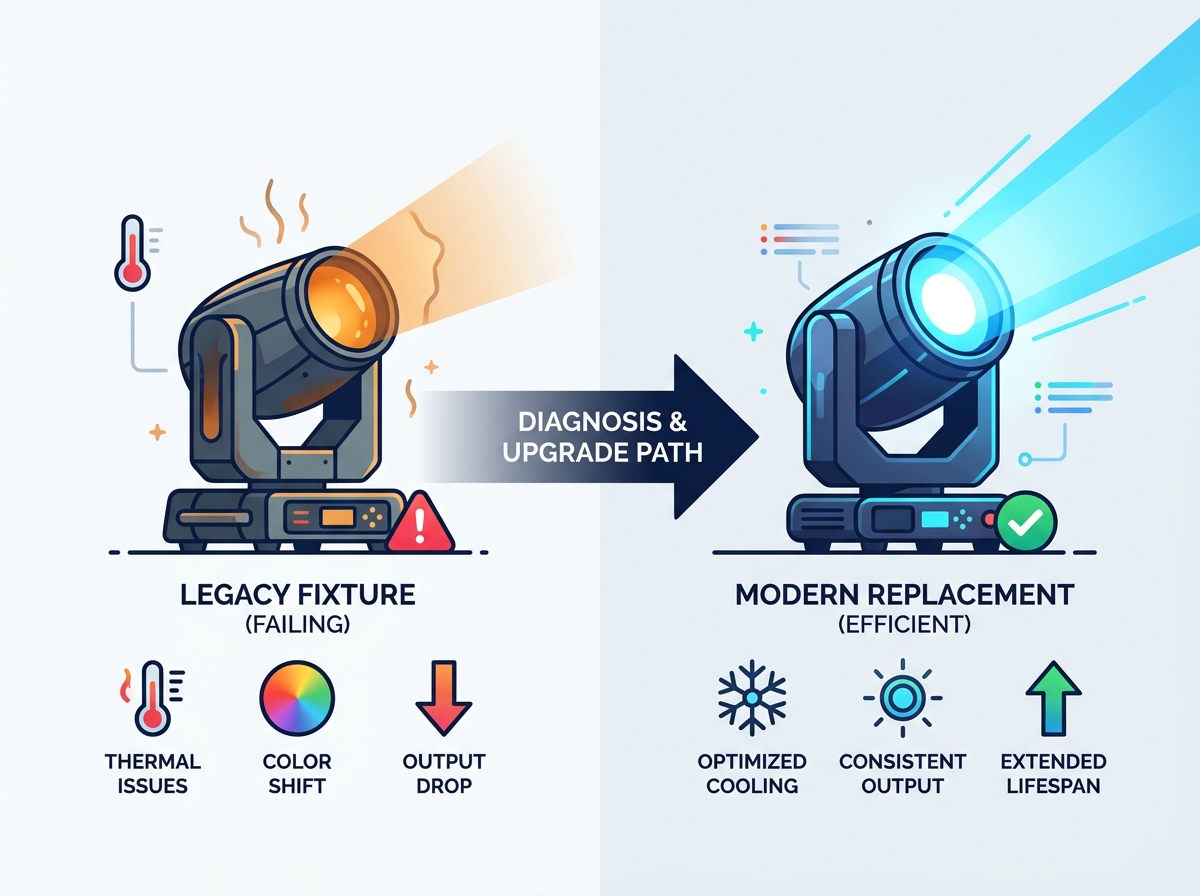
You should analyze color shifting and output drops closely. This "dying light" effect acts as a leading indicator of severe thermal damage. When an LED engine overheats repeatedly, the phosphor coating degrades. This degradation permanently alters the color temperature and slashes lumen output. Once a fixture begins showing inconsistent blues or faded reds, the damage is typically irreversible. Replacing the diode board often costs nearly as much as a new fixture.
Deciding when to retire old gear requires careful analysis. Sourcing proprietary replacement parts for legacy fixtures gets harder every year. Manufacturers discontinue older product lines, forcing you to hunt for salvaged parts. You must weigh the expense of these rare parts against the value of current-generation warranties. New fixtures offer guaranteed uptime and reliable manufacturer support.
Do not ignore the hidden labor costs of failing legacy fixtures. Constantly patching a problematic unit consumes valuable tech time. Technicians spend hours dropping fixtures from the truss, replacing stepper belts, and re-calibrating optics. This reactive maintenance drains resources. When your crew spends more time repairing older units than programming shows, you have reached the tipping point for replacement.
You must read manufacturer spec sheets skeptically. Many brands advertise massive peak lumen outputs. However, these peak numbers only reflect the first few seconds of operation. As the LED engine heats up, thermal throttling kicks in to protect the diodes. This throttling causes a significant drop in brightness.
Focus entirely on sustained lumens. A reliable fixture maintains its brightness after 30 minutes of continuous operation at full intensity. Ask vendors for thermal drop-off charts rather than relying on marketing materials. Evaluating sustained output ensures your stage looks just as bright during the encore as it did during the opening number.
Table Title: Comparing Output Metrics for Moving Heads
Metric Type | Definition | Operational Reality |
|---|---|---|
Peak Output | Maximum lumens measured instantly upon striking. | Rarely sustainable; drops quickly due to thermal limits. |
Sustained Output | Average lumens measured after 30 minutes of full intensity. | Accurate representation of real-world show conditions. |
Thermal Drop-off | Percentage of brightness lost as the fixture heats up. | High quality fixtures keep this loss below 10%. |
Evaluate the internal heat sink design carefully. Massive, well-machined heat sinks pull heat away from sensitive components efficiently. Variable-speed fan technology also plays a crucial role. These fans adjust their speed based on internal temperature sensors, preventing premature diode failure.
Acoustic performance matters immensely in noise-sensitive environments. Theaters, houses of worship, and broadcast studios cannot tolerate roaring cooling fans. Establish acceptable decibel (dB) thresholds before purchasing. A standard theater-acceptable noise floor usually sits below 30dB measured at one meter. Demand exact acoustic specifications from your vendor.
Batch consistency is critical for professional lighting rigs. You need to assess CMY (Cyan, Magenta, Yellow) color mixing across multiple units. If you line up twelve wash fixtures, they must produce the exact same shade of amber. Inconsistent dichroic filters ruin the cohesive look of a stage design.
Verify the Color Rendering Index (CRI) requirements for your specific application. Camera sensors require much higher CRI than the human eye to reproduce skin tones naturally. Broadcast environments typically demand a CRI of 90 or higher. Failing to meet these optical standards leads to poor video recordings and unflattering live feeds.
Arena tours and outdoor festivals demand extreme performance. Beam and hybrid fixtures dominate these environments. You need massive punch to cut through atmospheric haze and video wall brightness. Rapid pan and tilt speeds are mandatory for aggressive aerial effects and synchronized sweeps.
Durability under heavy touring conditions takes priority here. Road crews subject fixtures to constant vibration, temperature swings, and rough handling. Look for robust chassis designs and secure internal wiring. Outdoor festivals also require IP65-rated enclosures to protect against rain and humidity. Water ingress easily triggers a Moving Head Dying Light failure mid-concert.
Theatrical productions and houses of worship prioritize subtlety and precision. Wash and profile fixtures serve these spaces best. Framing shutters allow lighting designers to isolate specific set pieces or speakers without spilling light onto projection screens. Precise shutter calibration is a non-negotiable feature.
High CRI ensures costumes and skin tones look natural. Furthermore, near-silent operation prevents distractions during quiet dramatic moments or prayers. You should prioritize fixtures featuring studio mode settings, which cap fan speeds to eliminate background noise.
Nightclub installations and architectural applications present unique challenges. These fixtures run for eight to twelve hours daily. You must prioritize longevity and low-maintenance designs. High-hour usage environments quickly destroy poorly built LED engines.
Dust resistance becomes a critical factor. Nightclubs utilize heavy fog and haze, which leaves a sticky residue on internal lenses and fans. This residue traps heat, accelerating diode failure. Choose fixtures featuring sealed optical paths. These sealed designs drastically reduce cleaning intervals and extend the unit's lifespan.
New hardware must communicate flawlessly with your existing control systems. Always verify fixture profiles against your standard lighting consoles, such as GrandMA, Avolites, or Onyx. If a manufacturer fails to provide accurate, pre-built console profiles, your programmers will waste hours building them from scratch.
Assess protocol support carefully. Standard DMX512 remains the baseline. However, modern rigs require RDM (Remote Device Management) for remote addressing and status monitoring. Large installations also need network protocols like Art-Net or sACN. These network protocols allow you to push thousands of control parameters over a single ethernet cable, simplifying complex setups.
Replacing lightweight legacy fixtures with heavy, modern profiles introduces structural risks. You must calculate total payload limits on existing truss structures. Always analyze the weight-to-output ratio. A fixture might offer incredible brightness, but if it weighs 80 pounds, it might overload your current motorized hoists.
Power distribution limits require careful planning. Understand your power daisy-chaining limitations. True1 and PowerCON loop-outs offer immense convenience, but you cannot exceed the cable's maximum amperage. Calculate the exact current draw of your new fixtures. Ensure you match voltage requirements to avoid tripping breakers during intense strobe sequences.
Mixing a dozen different fixture brands creates an operational nightmare. Standardizing a single brand or series offers massive operational benefits. Your technicians learn one menu system, one maintenance routine, and one set of error codes.
Standardization simplifies spare parts inventory dramatically. You only need to stock one type of stepper motor, one style of cooling fan, and one set of custom gobos. Firmware updates also become significantly easier. Updating forty identical fixtures via network takes minutes, whereas updating a mixed rig takes all day.
Do not base your purchasing decisions solely on the initial price tag. Cheap fixtures often fail within the first year, wiping out any upfront savings. Look beyond the purchase price to assess Mean Time Between Failures (MTBF) data. Reputable manufacturers track and share this reliability data openly.
Investigate the brand's history in the industry. Speak to other production companies about their long-term experiences. A manufacturer's track record tells you how their hardware holds up after three years of abuse on the road. Prioritize companies known for rigorous quality control.
Hardware inevitably breaks, even from top-tier brands. Your vendor's support infrastructure determines how quickly you recover. Verify the local availability of replacement parts. If a specific belt snaps, you cannot wait four weeks for international shipping.
Review warranty turnaround times in writing. Ask about direct technical support access. Can your technicians call a dedicated support line during a weekend load-in? Transparent supply chains and responsive customer service eliminate the stress of emergency repairs.
Never commit to a bulk purchase without testing the hardware first. The Proof of Concept (PoC) phase protects your investment. Request a demo unit from your shortlisted vendors.
Follow these best practices for a successful PoC:
Side-by-Side Testing: Hang the demo unit right next to your existing rig elements.
Color Matching: Attempt to match the new unit's color palette with your older fixtures using the console.
Stress Testing: Run the fixture at 100% intensity for three hours to observe thermal throttling and fan noise.
Dimming Curves: Slowly fade the unit from 10% to zero to check for stepping or flickering.
This hands-on evaluation reveals flaws spec sheets hide. It ensures the fixture actually solves your problems before you spend your budget.
Solving chronic fixture failure requires shifting your mindset from reactive repairs to a proactive, standardized lighting strategy. Treating a failing moving head as a mere inconvenience drains your budget and your crew's morale. You must acknowledge when legacy hardware reaches the end of its useful life.
The best technical solution always balances optical performance with infrastructure reality. Massive lumen output means nothing if the fixture exceeds your truss weight limits or overloads your power distribution. Take action today by taking the following steps:
Audit your current rig to identify fixtures experiencing high failure rates.
Calculate the hidden labor hours spent repairing older units over the last six months.
Define your hard constraints regarding weight, power draw, and acoustic limits.
Initiate a structured vendor PoC to test top contenders in your actual performance space.
A: Loss of brightness stems primarily from LED lumen depreciation and phosphor degradation caused by excessive internal heat. As the cooling system ages, temperatures rise, permanently damaging the diodes. Additionally, dust accumulation along the optical path and on internal lenses significantly reduces light transmission over time.
A: First, isolate the data signal. Bypass the DMX chain and use the fixture's internal test sequence. If the head moves smoothly, you have a DMX/RDM signal or console patching issue. If you hear physical grinding, clicking, or see stuttering during the internal test, you have mechanical stepper motor wear or belt slippage.
A: No fan-cooled fixture is entirely silent. Manufacturers use "silent" as a marketing term for extremely quiet operation. Standard theater-acceptable noise floors sit at sub-30dB when measured at one meter. Studio-mode settings lower fan speeds to hit this threshold, though they may slightly reduce maximum lumen output.
A: Modern LED engines typically rate between 20,000 and 50,000 hours of continuous operation before dropping to 70% of their original brightness. However, you must exercise caution regarding mechanical wear. Fans, stepper motors, and belts often require replacement long before the LED engine actually fails.


