
 English
Views: 0 Author: Site Editor Publish Time: 2026-09-16 Origin: Site


Investing in moving head fixtures represents a major capital expense. Selecting the wrong type often leads to washed-out stages. It can also cause bloated DMX programming or hardware failures mid-tour. The current market is heavily saturated. Manufacturers constantly push exaggerated lumen claims. They also use confusing hybrid classifications. This makes it difficult to match fixture specs to your actual venue requirements. You need clarity to make the right choice.
We provide an objective, criteria-driven breakdown of moving head types. We will explore technical evaluation standards and deployment realities. Our guide helps you shortlist the exact fixtures your production demands. You will learn how to evaluate optics, manage power loads, and avoid common rigging mistakes.
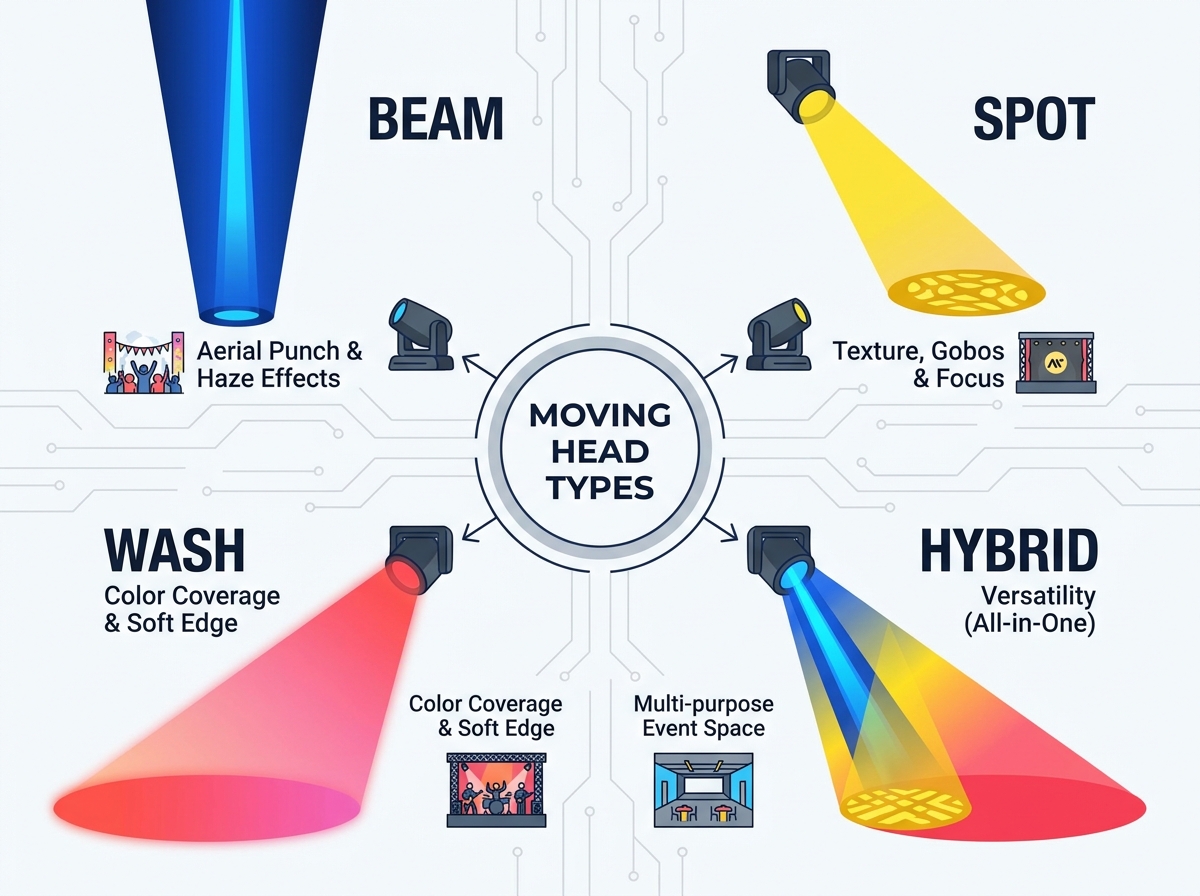
Purpose Dictates Type: Spots provide texture (gobos), Beams offer aerial punch, and Washes deliver stage coverage. Hybrids offer versatility but often compromise on maximum output for specific tasks.
Look Beyond Wattage: True performance is measured in lux at specific distances and optical efficiency, not just raw LED wattage.
Infrastructure Matters: Rigging weight, power draw (daisy-chaining limits), and DMX channel counts must align with your current trussing and console capabilities.
Dimming Quality: Professional fixtures require 16-bit dimming to execute smooth fade-outs without the abrupt drop-offs common in cheaper models.
You must evaluate your physical venue before browsing fixture catalogs. A high-end fixture performs poorly if placed in the wrong environment. You need to align your lighting choices with your structural realities.
Throw distance dictates your necessary beam angles and lumen output. You calculate this by measuring the distance from your truss to the stage or floor. A long throw distance requires tighter beam angles to maintain intensity. Light follows the inverse square law. It loses intensity rapidly as it travels through the air. You should request photometric data showing lux at your specific throw distance. Do not rely on measurements taken right at the lens.
Smart productions build their rigs systematically. You should always buy fixtures in multiples of four. Symmetry is crucial for stage design. Buying in pairs or fours allows for balanced truss layouts. Sticking to consistent brands and DMX profiles reduces programming friction. Mixed inventories force you to patch multiple profiles. They also complicate color matching. Consistent inventories future-proof your rig and simplify operation.
Consider these three scalability rules:
Always purchase identical fixtures to maintain uniform color temperatures.
Ensure your lighting console can handle the combined channel count of future expansions.
Keep spare fixtures in your inventory to cover unexpected maintenance issues.
Buyers often forget the hidden costs of essential accessories. Bare fixtures cannot safely hang from a truss. You must account for flight cases to protect your gear during transport. Robust safety cables are non-negotiable for overhead rigging. Omega brackets allow for quick attachment to truss clamps. Upgraded DMX cabling ensures reliable signal transmission across long runs. These peripherals are necessary components of a functioning lighting rig.
Moving Head Category Comparison
Fixture Type | Beam Angle Range | Edge Quality | Primary Application |
|---|---|---|---|
Beam | 1° - 5° | Ultra-Sharp | Aerial atmospheric effects |
Spot | 10° - 35° | Hard-Edged | Gobo projection, texture |
Wash | 15° - 60°+ | Soft-Edged | Stage coverage, base color |
Hybrid | Variable (2° - 40°) | Adjustable | Versatile multi-role use |
Understanding fixture classifications prevents costly specification errors. Each category serves a distinct visual purpose on stage.
Beam fixtures cut through the air with incredible intensity. They feature ultra-narrow beam angles, typically ranging from 1° to 5°. These tight angles concentrate the light output into a piercing shaft. You design these effects to be seen mid-air, usually paired with theatrical haze. They are the go-to choice for EDM festivals and large-scale touring. Beams provide the high-energy focal points audiences expect at major concerts.
Spots act as the workhorses of theatrical and concert lighting. They deliver a hard-edged output. These fixtures come equipped with rotating and static gobo wheels. They also feature prisms and motorized focus capabilities. You use spots for projecting logos onto walls or adding texture to blank stages. Their sharp optics make them perfect for versatile mid-air effects. You can precisely control where the light lands.
Wash fixtures bathe large areas in consistent light. They emit a soft-edged light with wide beam angles. These units excel at color mixing, usually employing RGBW or CMY systems. You deploy them for front lighting performers to eliminate harsh shadows. They perfectly illuminate large backdrops. Washes create the general stage moods and baseline colors for your production.
Hybrids combine multiple functions into a single chassis. They utilize advanced optics to shift between Beam, Spot, and Wash modes. This versatility sounds perfect, but you must consider the caveats. Hybrids are heavier, more expensive, and structurally complex. They are ideal when truss space is strictly limited. However, they rarely beat a dedicated wash fixture for pure, soft-edge coverage.
You must look past the marketing brochures. Technical evaluation requires digging into photometric data and optical design.
Raw LED wattage tells an incomplete story. A poorly designed 300W fixture might output less usable light than a highly efficient 200W fixture. You need to read photometric data sheets accurately. Look for lux measurements at 5 meters or 10 meters. Assess the uniformity of the beam field. A hot spot in the center with dark edges indicates cheap optics. Optical efficiency determines how much light actually reaches your stage.
Color rendering capabilities separate professional fixtures from budget options. CMY relies on subtractive color blending. It excels at producing subtle pastels and deep theatrical colors. RGBW uses additive brightness, which is great for punchy, saturated colors at standard events. You must evaluate the Color Rendering Index (CRI) for any on-camera applications. Houses of Worship and broadcasted events require high CRI to render skin tones naturally. Low CRI fixtures make performers look sickly on camera.
Dimming quality dictates the emotional flow of a performance. You must evaluate the 16-bit dimming capabilities of any prospective fixture. Professional shows demand smooth fades down to zero intensity. Budget fixtures struggle with this transition. They often snap off abruptly at 5-10% intensity instead of fading smoothly to black. This abrupt drop-off is known as the Moving Head Dying Light effect. It ruins theatrical moments and distracts audiences. You avoid this by specifying fixtures with selectable, high-resolution dimming curves.
Fast, accurate movement is critical. You should check the pan and tilt resolution. Look for 16-bit movement to ensure slow, sweeping motions remain smooth without jittering. Evaluate motor noise carefully. High-speed continuous rotation enables advanced programming and dynamic effects. Precision motors ensure your fixtures hit their programmed positions accurately every single time.
Theoretical specs matter little if your infrastructure cannot support the fixtures. You must account for power, heat, and environmental factors.
Power management prevents mid-show blackouts. You must calculate the maximum fixture daisy-chaining limits on standard 15A or 20A circuits. Look for reliable connections like PowerCON or True1. A standard 20A circuit in the US safely supports about 1920 watts under the 80% continuous load rule. If a fixture draws 400W, you can safely link four units on one circuit. Always calculate peak power draw, not just average consumption.
Check the fixture's maximum wattage at full intensity.
Map out your venue's available circuit breakers.
Never exceed the current rating of your linking cables.
High-wattage LEDs generate significant heat. Fixtures rely on internal fans to prevent thermal throttling. You face a direct trade-off here. Keeping LEDs cool often requires aggressive fan speeds, which raise the noise floor. This noise is unacceptable for theatrical or acoustic performances. You must select fixtures with intelligent fan control or specific "silent modes" if you work in noise-sensitive environments.
Environmental protection dictates where you can safely hang your lights. Outdoor festivals require IP65-rated fixtures. These units resist dust and rain. However, IP65 protection adds significant weight and increases the purchase price. Standard IP20 fixtures work perfectly well for indoor clubs and theaters. You must weigh the necessity of weatherproofing against the added structural load on your truss.
Moving heads require regular upkeep to perform reliably. You must factor in maintenance accessibility. Can you easily open the housing to clean the lenses? Are the gobo wheels accessible for quick replacements? Long-term use stretches the internal drive belts. You will eventually need to perform motor recalibrations. Choose fixtures with clear service manuals and accessible modular components to reduce repair downtime.
No single fixture solves every lighting challenge. You must match the hardware to your specific operational environment.
Touring rigs face harsh conditions. You should prioritize IP65 Hybrids and intense Beams. Reliability and weatherproofing are your primary concerns. Maximum lux output is essential to cut through large outdoor spaces. These environments demand heavy-duty rigging hardware. You want fixtures that survive rough transport and extreme weather without constant repairs.
Mobile operators value portability and ease of use. You should prioritize lightweight Spots and Washes. Look for units with robust built-in sound-active macros for quick deployment. Ease of transport is critical when loading out alone at 2 AM. Low power draw is also vital. You often plug into standard wall outlets in hotel ballrooms. Efficient fixtures prevent tripped breakers during corporate events.
Theatrical venues require subtlety and precision. You should prioritize fanless or low-noise Spots alongside high-CRI Washes. Focus heavily on color accuracy for natural skin tones. Smooth, theatrical dimming is mandatory here. You must avoid the dreaded Moving Head Dying Light scenario during quiet acoustic sets. Select units designed specifically to fade cleanly down to zero percent.
No single moving head does everything perfectly. The "best" fixture directly answers your venue's primary constraints. You must identify your throw distance, weight limits, and console capacity first. Once you know these limits, the choice becomes clear. Spots bring texture. Beams deliver punch. Washes provide base coverage. Hybrids offer compromise.
Take action before making a bulk purchase. We highly recommend booking a live demo. Rent a pair of your shortlisted fixtures for a test run in your actual venue. Consult with a local AV integrator to verify your power and rigging calculations. Hands-on testing guarantees your final investment will elevate your production quality.
A: A Spot creates hard-edged light and uses gobos to project patterns or logos. They have wider angles (10°-35°) for texturing stages. A Beam emits a narrow, intense shaft of light (1°-5°). You use beams primarily for mid-air atmospheric effects paired with haze.
A: Professional units typically require between 15 and 35+ channels. They offer standard and extended modes. Standard mode groups basic functions. Extended mode provides granular 16-bit control over pan, tilt, dimming, and individual LED pixels for complex programming.
A: CMY uses subtractive blending, making it ideal for precise theatrical pastels and subtle color transitions. RGBW uses additive brightness. RGBW is generally enough for standard events, concerts, and clubs where punchy, saturated colors are the priority.
A: While the LED light source typically lasts around 50,000 hours, internal mechanical parts wear out faster. Pan and tilt belts usually require tensioning or replacement every 2 to 3 years. Regular maintenance and lens cleaning significantly extend the fixture's mechanical lifespan.


