
 English
Views: 0 Author: Site Editor Publish Time: 2025-07-13 Origin: Site


When I use moving head stage lighting, I see a powerful stage lighting fixture that can move and change direction during a show. These moving head lights use stepper motors and electronic chips to control pan and tilt, so I can point stage lights anywhere on stage with precision. The moving head light fixture responds quickly to DMX signals from a lighting console, letting me create dynamic effects and patterns that static stage lighting instruments cannot. Moving heads let me switch colors, shapes, and positions in real time, making them essential intelligent lighting fixtures for any modern stage. I find moving stage light options like wash, spot, and hybrid moving lights bring unmatched versatility to stage lighting fixtures. As moving lights grow more advanced, they help transform stage lights into automated lighting fixture solutions that make every show more exciting. If you ever wondered how do moving lights work, the answer lies in their smart mechanics and real-time control.
When I work with stage lights, I often choose from four main types of moving head lights. Each type gives me different effects and fits specific needs on stage.
Spot moving head lights create a focused, sharply defined beam. I use them when I want to highlight a performer or an object on stage. These lights often let me project patterns or shapes, called gobos, onto the stage. I find spot moving head lights perfect for concerts, weddings, and corporate events. They help me add detail and drama to any show. When I need to project logos or create special effects, I always reach for a spot moving head light.
Beam moving head lights produce a narrow, intense beam of light. The beam angle usually falls between 5° and 15°. I use beam moving head lights to create dramatic aerial effects, especially at concerts and music festivals. These lights cut through haze or fog, making bright, visible shafts of light that sweep across the crowd. I love using beam moving head lights for high-energy shows because they add excitement and movement. They are not ideal for lighting performers, but they make the whole stage look alive.
Tip: I always use haze or fog with beam moving head lights to make the beams stand out.
Wash moving heads give me a broad, soft-edged beam. I use them to cover large areas with even light and color. These moving head lights are great for illuminating backgrounds, scenery, and crowds. I rely on wash moving heads in theaters, churches, and nightclubs. They help me set the mood and create a colorful atmosphere. When I want smooth, blended light across the stage, I choose wash moving heads.
Hybrid moving heads combine the features of spot, beam, and wash fixtures in one unit. I find these moving head lights very flexible. I can switch between a sharp beam, a wide wash, or a focused spot without changing fixtures. Hybrid moving heads save space and budget, especially in venues with limited equipment. I use them for events that need quick changes and many effects. They let me stay creative while keeping my setup simple.
Here’s a quick comparison of where I use each type:
| Moving Head Type | Common Events / Venues | Key Uses / Features |
|---|---|---|
| Beam | Festivals, concerts, nightclubs | Dramatic aerial effects, narrow beams |
| Spot | Weddings, theaters, corporate events | Pattern projection, performer highlighting |
| Wash | Theaters, churches, EDM events | Broad coverage, mood lighting |
| Hybrid | Multi-purpose venues, budget setups | Versatile, combines all effects |
Spot moving head lights: Best for detailed effects and highlighting.
Beam moving head lights: Best for high-impact, moving beams.
Wash moving heads: Best for even, colorful coverage.
Hybrid moving heads: Best for versatility and quick changes.
When I operate moving head lights, I rely on their precise pan and tilt movement to create dynamic effects on stage. Each moving head light uses high-precision three-phase motors that allow the head to rotate horizontally (pan) and vertically (tilt). I can achieve smooth and accurate positioning, which is essential during live performances. Most professional moving head lights offer a pan range of up to 360 degrees and a tilt range of up to 270 degrees. Some advanced models even provide unlimited 360-degree rotation for both pan and tilt. This wide range of motion lets me cover every corner of the stage and direct beams exactly where I want them.
The pan and tilt mechanism responds instantly to my commands from the dmx controller. I can program complex sequences that synchronize with music or visual cues. This level of control ensures that my stage lights always match the rhythm and mood of the show. When I use moving head lights, I can illuminate performers from different angles, highlight key moments, and create immersive visual experiences for the audience.
Tip: I always test the pan and tilt range before a show to make sure my moving head lights can reach every spot I need.
The gimbal system is the heart of every moving head light. This system allows the fixture to move in multiple directions, giving me full control over where the light points. Unlike traditional static stage lights, which stay fixed in one position, moving head lights with a gimbal system let me adjust the position, color, intensity, and effects in real time. I can make changes remotely using a dmx controller, which means I do not need to climb up and manually adjust each light.
This flexibility makes moving head lights much more versatile than static fixtures. I can create dynamic lighting changes that follow performers, highlight different areas, or shift the mood instantly. The gimbal system also allows me to integrate moving head lights with other stage technologies, such as video mapping and automated rigging systems. By combining lighting, visuals, and moving stage elements, I can design shows that keep the audience engaged and make every scene transition seamless.
To control moving head lights, I use dmx 512 control. This system sends digital signals from my dmx controller to each light, telling it how to move, what color to display, and which effects to use. Each moving head light has its own set of DMX channels. Simpler models might use just a few channels for basic functions like dimming and color mixing. More advanced fixtures can use many channels to control pan, tilt, focus, zoom, gobos, prisms, and more.
Here is a quick look at common DMX channel configurations:
| Fixture Type | Typical DMX Channels | Functions Controlled |
|---|---|---|
| Basic RGB | 3 | Red, Green, Blue |
| RGBW | 4 | Red, Green, Blue, White |
| Advanced Moving Head | 12+ | Pan, Tilt, Color, Gobo, Zoom, Effects |
When I set up my stage lights, I assign each fixture a unique DMX address to avoid channel overlap. More channels give me more control, but they also make programming more complex. I often use lighting software with a graphical interface to manage all the parameters. For simple shows, I might use master/slave mode, where one moving head light controls others, or standalone mode, where fixtures run pre-programmed sequences without a dmx controller.
DMX 512 control is not the only option. Many moving head lights also support auto, sound-activated, or remote control modes. These options let me run basic effects without a full dmx controller setup. However, for professional shows, I always prefer dmx 512 control because it gives me the most precise and flexible control over my moving lights.
Note: DMX 512 control allows me to synchronize moving head lights with other stage technologies, such as video walls and automated rigging, for a truly immersive show.
When I compare moving head lights to static stage lights, the difference is clear. Static lights can only illuminate one spot unless I move them by hand. Moving head lights, controlled by dmx 512 control, can follow cues, change direction, and adapt to any scene in real time. This ability answers the question, "how do moving lights work?" They work by combining motorized movement, a gimbal system, and advanced control options to deliver unmatched versatility and excitement on stage.
When I use a led moving head, I notice how advanced color mixing systems make a huge difference. Most led moving heads use either RGBW (Red, Green, Blue, White) or CMY (Cyan, Magenta, Yellow) color mixing. These systems let me create almost any color I want. I can smoothly fade from one color to another, which helps me match the mood of each scene. The CMY system gives me precise control over color hue and intensity. I find that merging technology in these fixtures ensures consistent and saturated colors across the stage. I always rely on led moving head lights for accurate and vibrant color transitions during live shows.
Tip: I use colorimeters to check color accuracy and keep my lighting consistent, even when the temperature or humidity changes.
Gobos and pattern wheels are some of my favorite features in a led moving head. I can project static or rotating patterns onto the stage, which adds texture and excitement to my lighting design. Some fixtures offer up to 24 gobo patterns and 13 graphic effects in 12 colors. I use these to create spinning, rippling, or even flame-like visuals. Animation wheels and color wheels with dichroic filters give me even more creative options. When I want to make a show unforgettable, I combine gobos with color effects and movement.
The zoom feature in a led moving head lets me adjust the beam angle from a tight spot to a wide wash. This flexibility helps me cover small or large areas as needed. I often use fixtures with a zoom range from 4° to 60°, depending on the venue. Here’s a table showing typical zoom ranges and their impact:
| Model | Zoom Range (degrees) | Application | Impact on Stage Coverage |
|---|---|---|---|
| PZ1940 | 4° to 45° | Clubs, weddings | Narrow spots and wide washes for flexible setups |
| W3725-High CRI | 8° to 60° | Studios | Wide shots and close-ups, great for TV and film |
| PZ3740 | 6° to 55° | Outdoor concerts | Broad, intense illumination for large events |
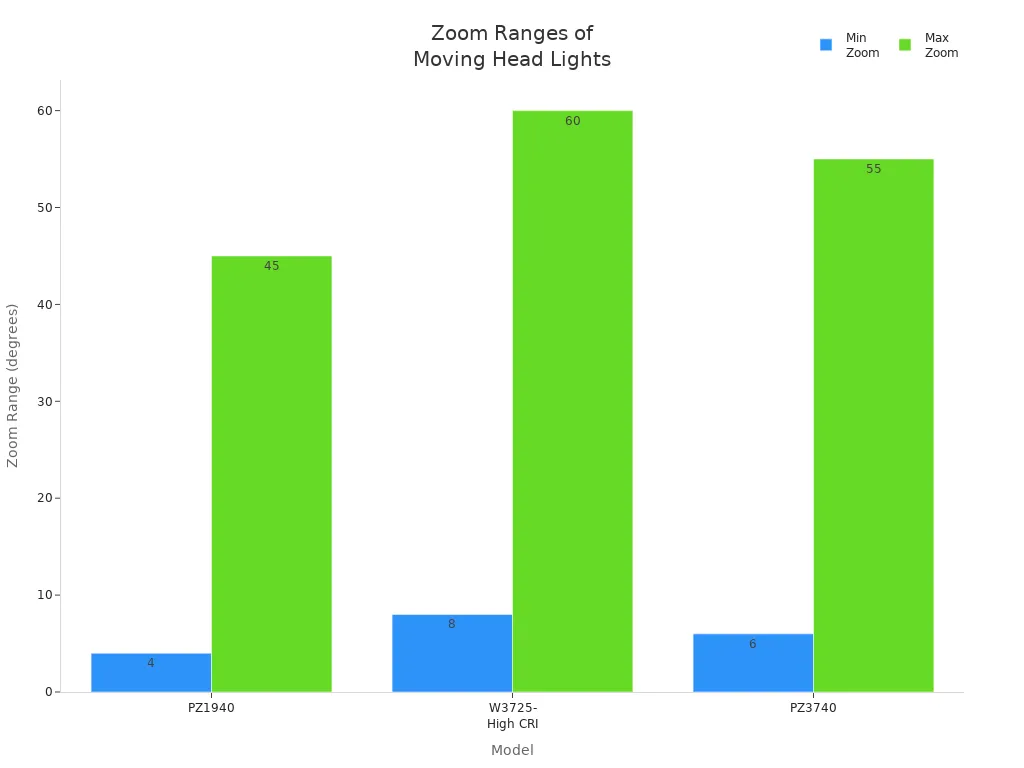
I adjust the zoom to fit the space and effect I want. This makes led moving head lights perfect for any event, from small clubs to big outdoor concerts.
Prisms in a led moving head split the beam into multiple smaller beams. I often use 8-prism or 16-prism systems to create a kaleidoscope effect. These prisms rotate in both directions and can overlay for even more complex visuals. When I add prisms to my lighting, I see the stage come alive with depth and movement. The effect is especially stunning when I combine it with high-powered leds, gobos, and color changes. This feature helps me keep the audience engaged and the show visually rich.
Note: Led moving head lights are more energy-efficient, last longer, and require less maintenance than older lamp-based models. They also run cooler and operate quietly, making them ideal for any venue.
When I plan lighting for live events, I always start by looking at the venue and the type of event. Choosing the right beam moving head depends on the stage layout, the size of the space, and the effect I want to create. For a small club or a theatrical production, I pick compact moving heads with quiet motors and broad beam angles. These lights give me soft washes or focused spotlights without distracting the audience. In a large concert hall or an outdoor festival, I need high-output moving heads with narrow beams. These powerful fixtures help me reach distant areas and cut through ambient light.
Here’s how I match moving head lights to different venues and events:
I measure the stage and check the shape.
I decide if I need foreground, background, or effect lighting.
I choose fixture positions and angles for the best coverage.
I adjust intensity by picking the right wattage and number of lights.
I use colored LEDs or filters to set the mood.
I always check for safety, making sure cables are managed and fixtures are secure.
For live events like concerts, I use a mix of beam, spot, and wash moving heads to create dynamic effects. At an outdoor festival, I select waterproof moving heads to handle weather changes. When choosing the right beam moving head, I focus on the lighting effect I want—sharp patterns, wide washes, or long-distance beams.
Budget plays a big role when I choose moving head lights. Entry-level models start around $50, while mid-range options can cost up to $1,900. Professional-grade fixtures for large venues or complex shows cost much more. I always balance my needs with my budget, making sure I get the best value without sacrificing quality.
| Category | Entry-Level | Mid-Range | Professional (High-End) |
|---|---|---|---|
| Price Range | $50 - $300 | $250 - $1,900 | $1,200 and up |
Control options also affect my decision. DMX control gives me precise programming for complex shows. Wireless DMX saves me time and money on cables, making setup easier. Manual controls or simple auto modes work well for smaller events or when I need quick changes. When choosing the right beam moving head, I always check if it supports DMX, wireless, or manual control to match my event’s needs.
Tip: Wireless DMX reduces cable clutter and speeds up setup, especially for live events with tight schedules.
I look for user-friendly features when I set up moving head lights, especially if my team has limited technical experience. Modern fixtures often have touchscreen panels, mobile app control, and preset modes like sound-activated or auto-run. These features help me get great results without deep programming knowledge.
Some of the easiest moving head lights to use offer:
Intuitive interfaces with clear menus
Wireless DMX for simple setup
Lightweight, durable designs for easy mounting
Built-in safety features like temperature monitoring
When choosing the right beam moving head, I always test the controls and setup process. If I can operate the light quickly and safely, I know it will work well for my event. For live events, easy-to-use fixtures let me focus on creativity instead of troubleshooting.
When I use moving head stage lighting, I see how it transforms any event with dynamic lighting effects and dramatic lighting effects. These moving head lights let me pan, tilt, and change colors or patterns, creating dynamic lighting environments that keep the audience engaged. By understanding the types and features of moving head lights, I can choose the best stage lights for any venue or show. If you want flexible and creative stage lighting, moving head stage lighting is the smart choice.
I find that moving head stage lights give me flexibility. I can point them anywhere on stage, change colors, and create effects without moving the fixture by hand. This makes my lighting setup much more dynamic.
Yes, I often use moving head lights outdoors. I always check if the fixture is rated for outdoor use. Waterproof models work best for concerts, festivals, and events outside.
I do not need special training for basic use. Most fixtures have user-friendly controls. For advanced programming, I recommend learning DMX basics. Many manufacturers offer tutorials and manuals.
LED moving head lights usually last 20,000 to 50,000 hours. I notice they need less maintenance than older lamp-based models. I always check the manufacturer's specs for exact lifespan.
Many modern moving head lights support app control. I use my phone or tablet to adjust settings, colors, and effects. This makes setup and operation much easier, especially for small events.


