
 English
Views: 0 Author: Site Editor Publish Time: 2026-09-12 Origin: Site


Live stage productions carry incredibly high stakes. Moving head fixtures demand a significant capital investment. They serve as the true backbone of modern stage design. Poor procurement decisions often lead to catastrophic mechanical failures. You might experience disruptive fan noise or completely ruined artistic transitions. Today, buyers navigate a complex, saturated market. You must carefully choose between overloaded hybrid units and highly specialized fixtures. Lighting professionals need to balance raw technical specifications against actual output quality. This guide provides lighting designers and production managers a strictly evidence-based evaluation framework. We will help you assess mechanical reliability. You will learn how to evaluate control precision and long-term hardware durability. Ultimately, this approach ensures confident shortlisting of the right fixtures. By focusing on proven performance metrics rather than marketing hype, you guarantee flawless show execution every night.
Categorization over Hype: Selecting between Beam, Spot, Wash, or Hybrid units should be driven by venue dimensions and rigging capacities, not just feature counts.
Precision is the Differentiator: True fixture quality is revealed in low-light transitions—such as executing a flawless moving head dying light effect without mechanical stepping or flicker.
Future-Proof Control: Standardizing on fixtures natively supporting Art-Net/sACN ensures scalability alongside traditional DMX512.
Live events and theatrical productions demand absolute, zero-downtime reliability. An audience immediately notices when a lighting cue fails. Inconsistent color mixing ruins stage aesthetics. Pan and tilt drift causes spotlights to miss their targets entirely. Loud motor noise actively sabotages quiet theatrical moments. These failures damage both a vendor’s reputation and the venue’s credibility.
A successful deployment requires strict evaluation criteria. You need fixtures delivering repeatable spatial accuracy. High-quality units utilize optical encoder feedback to maintain precise positioning. Thermal stability ensures light output remains consistent over a three-hour show. Furthermore, seamless integration into existing lighting consoles guarantees efficient programming.
Risk mitigation plays a major role in fixture selection. You must avoid the trap of over-specifying equipment. Many buyers purchase heavy, power-hungry 4-in-1 hybrid fixtures for every position. However, targeted, lightweight profile fixtures often provide better reliability. They impose lower weight constraints on your rigging infrastructure.
Best Practice: Always request a physical demonstration in your venue. Test fixtures under your specific stage conditions.
Common Mistake: Buying fixtures based purely on maximum lumen output. Brightness means nothing if the fixture cannot dim smoothly or maintain focus.
Modern moving heads fall into four primary categories. Each serves a distinct artistic purpose. You must align the fixture type directly with your production requirements.
Wash Fixtures provide ambient stage coverage. When evaluating wash units, look for even field distribution. Avoid fixtures producing noticeable hot spots. Assess the CMY color mixing speed. Fast color flags allow for snappy musical transitions. A wide zoom range, typically 5° to 60°, maximizes the fixture's versatility.
Beam Fixtures deliver tight, concentrated shafts of light. You must assess their optics and lux output at long distances. Beam units prove critical for aerial effects. They look stunning in environments filled with haze or fog.
Spot/Profile Fixtures project intricate patterns and sharp edges. Analyzing gobo clarity is essential here. You should also evaluate framing shutter precision. Profile fixtures handle theatrical front-lighting and precise staging.
Hybrid (Beam/Spot/Wash) Viability remains a debated topic. Hybrids offer undeniable versatility. However, you must weigh this against their physical weight penalty. Complex optical trains often compromise raw light output. Extra lenses absorb light energy.
Fixture Profile Evaluation Matrix
Fixture Category | Primary Application | Critical Evaluation Metric | Ideal Environment |
|---|---|---|---|
Wash | Broad stage illumination | Even color distribution & zoom range | Live music, broadcast, theatre |
Beam | Aerial effects | Lux at distance & narrow beam angle | EDM festivals, large arenas |
Spot/Profile | Precise subject lighting | Gobo clarity & framing shutters | Theatre, corporate presentations |
Hybrid | Multi-purpose flexibility | Optical efficiency vs. weight | Touring rigs, limited capacity trusses |
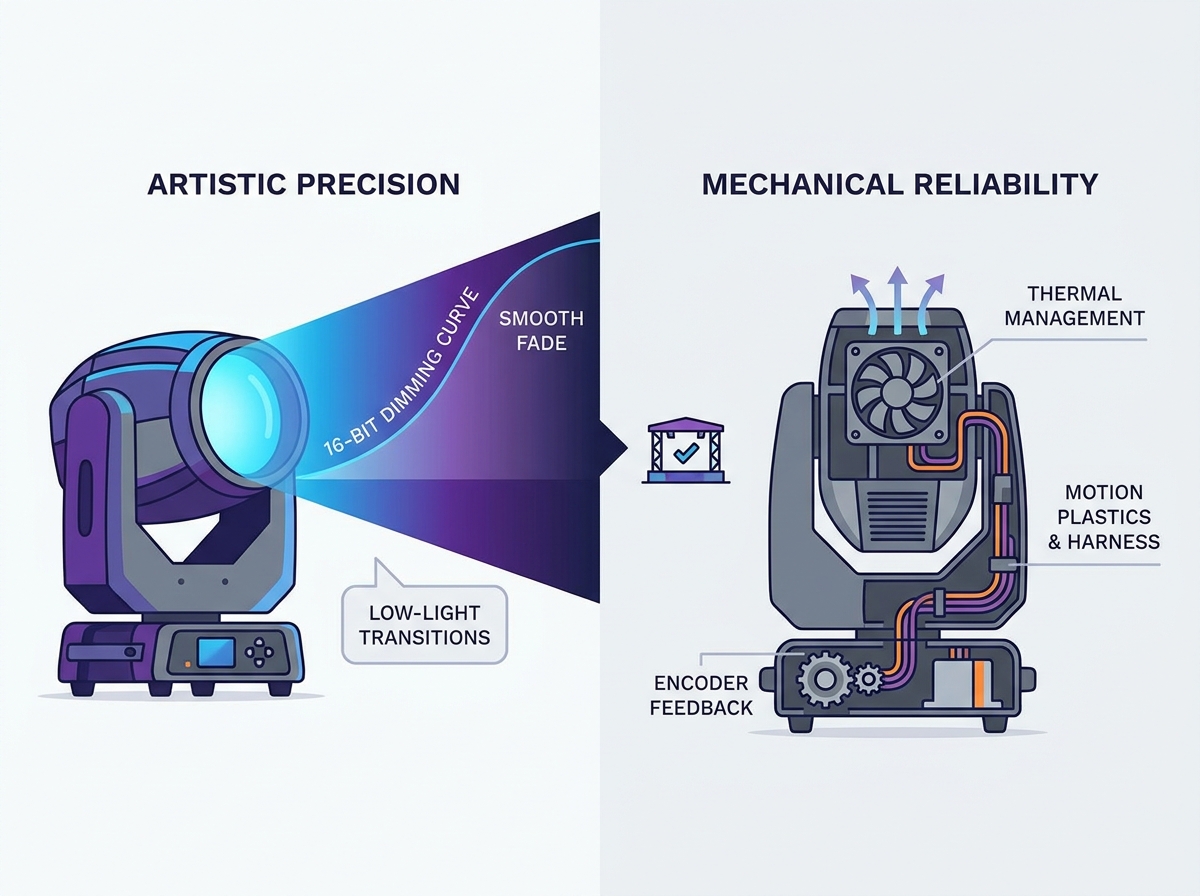
Industry professionals know the true test of a lighting fixture. The most rigorous benchmark is never 100% output. Instead, it is the delicate 10% to 0% fade. Budget fixtures struggle intensely at the bottom end of the dimming curve. They pop off abruptly instead of fading smoothly.
Creating dramatic, fading-to-black silhouettes requires exceptional engineering. Achieving a flawless Moving Head Dying Light effect demands ultra-smooth 16-bit dimming resolution. Standard 8-bit control provides only 256 steps of intensity. This low resolution creates a visible, jarring stepping effect during slow fades. Conversely, 16-bit control offers 65,536 steps. This high resolution ensures imperceptible transitions.
Pulse Width Modulation (PWM) dictates how LEDs dim. You must evaluate PWM refresh rates carefully. Broadcast environments require high-frequency PWM. Low refresh rates cause rolling bands on camera sensors. Flicker-free operation ensures low-light transitions translate flawlessly on video.
Color shift presents another major hurdle at low intensity. Inferior fixtures fail to maintain true CMY or RGBW color integrity. As they dim, the light often shifts strangely warm or cool. Premium fixtures utilize advanced algorithms. These internal processors maintain exact color temperatures during dramatic fade-outs.
Mechanical realities often dictate a fixture’s lifespan. Moving heads perform continuous pan and tilt rotations. This motion puts immense strain on internal wiring harnesses. High-quality fixtures utilize industrial-grade motion plastics. These specialized materials guide and protect internal cables. Proper cable management prevents catastrophic data drops mid-show.
Thermal management directly impacts performance. High-output LEDs and traditional discharge lamps generate massive heat. Internal fans must cool the heat sinks effectively. However, you must meticulously assess cooling fan noise levels. Quiet theatrical environments tolerate very little acoustic interference. Broadcast studios share this strict acoustic requirement. Look for fixtures offering variable fan modes or studio-silent operation.
Rigging limits govern your entire stage design. You must factor in the fixture's physical weight. Compare this against your venue's maximum truss load capacities. Heavy 4-in-1 fixtures require more labor to hang. They also demand specialized, heavy-duty rigging hardware. Overloading a truss poses severe safety risks. Lightweight profile fixtures often present a safer, more manageable solution.
Best Practice: Always inspect the internal wire routing when evaluating a demo unit. Look for protective sleeves and strain relief mechanisms.
Common Mistake: Ignoring acoustic profiles. A rig of 40 noisy moving heads will completely ruin a quiet dramatic monologue.
Lighting control technology evolves rapidly. You must evaluate the transition from standard DMX512 to network protocols. Modern rigs require high-bandwidth solutions like Art-Net and sACN. These Ethernet-based protocols handle thousands of parameters flawlessly. Furthermore, Remote Device Management (RDM) remains non-negotiable today. RDM allows programmers to troubleshoot rigged fixtures remotely. You can change DMX addresses without climbing a ladder.
Strategic positioning maximizes fixture efficiency. You must match technical specifications to intended hang points. Consider the following placement strategies:
Front-of-House (FOH): Prioritize fixtures with high CRI (Color Rendering Index). Accurate skin tone rendering is crucial for face lighting.
Upstage Backlighting: Prioritize raw speed and maximum lumen punch. Gobo projection matters less from this angle.
Floor Packages: Prioritize fast pan/tilt motors and compact footprints. Floor units often provide dynamic aerial sweeps.
Calibration and encoder feedback ensure positional accuracy. Stages experience vibrations. Dancers occasionally bump into floor fixtures. If a fixture is physically knocked out of position, it must adapt. Quality units immediately self-correct back to the console's programmed coordinates.
Smart procurement moves beyond the initial sticker price. You must evaluate the operational longevity of the equipment. Consider the maintenance lifespan carefully. If you purchase discharge fixtures, factor in the recurring cost of replacement lamps. Assess the regional availability of spare parts. Outdoor events and touring productions require high durability. Always check for verifiable IP65 weather-resistance ratings when operating outside.
Service Level Agreements (SLAs) determine your emergency support. Evaluate vendor turnaround times for Return Merchandise Authorization (RMA). Localized repair support saves productions. Shipping a heavy fixture overseas for repair wastes valuable time.
Compliance and safety remain paramount. Municipal fire marshals inspect live event rigs. Venue safety officers enforce strict codes. You must check for necessary certifications. CE, RoHS, and UL/ETL marks prove the fixture meets electrical safety standards.
Your next step requires physical validation. Always request an on-site shootout before executing a bulk purchase. Side-by-side physical demos expose a fixture's true capabilities. Manufacturer specification sheets rarely tell the whole truth.
Mastering moving head lighting demands a balanced approach. You must harmonize artistic features like color mixing and gobo projection with unglamorous mechanical realities. Internal cabling, cooling dynamics, and control protocols dictate long-term success. Theatrical magic relies entirely on mechanical stability.
Decision-makers must prioritize 16-bit control precision and mechanical durability. Executing complex transitions like the Moving Head Dying Light requires superior engineering. Pure lumen output and inflated feature lists matter far less than consistent reliability.
Take action today. Audit your current truss load capacities. Evaluate your existing control network bandwidth. Once you define your physical and technical limits, engage a vendor for a live product demonstration. Make your final choice based on evidence, not marketing.
A: The difference lies in step resolution. An 8-bit system offers only 256 steps of intensity between off and full brightness. This causes visible flickering or stepping during slow fades. A 16-bit system uses two control channels, providing 65,536 steps. This massive increase ensures buttery-smooth fades, especially at very low light levels.
A: You should purchase fixtures equipped with optical encoders on the pan and tilt motors. These sensors constantly read the fixture's physical position. If the unit gets bumped out of place, the auto-correction feature instantly drives the head back to the console’s commanded coordinates.
A: Yes. Modern high-wattage LED engines easily rival traditional discharge lamps in output. Furthermore, LEDs offer significant advantages. They produce a flatter, more even field of light. LEDs eliminate expensive routine lamp replacements. They also generate less forward heat, protecting stage talent and delicate props.
A: RDM stands for Remote Device Management. It operates over standard DMX lines. RDM enables two-way communication between the lighting console and the fixture. You need it because it allows remote addressing, status monitoring, and temperature diagnostics. This eliminates the dangerous need to lower trusses or climb ladders just to change a fixture's address.


